All-In-One Construction Accounting Software

The $480,000 Question That Generic Accounts Payable Automation Software Can’t Answer

Construction accounts payable (AP) has a problem that generic automation cannot solve by simply reading documents. A subcontractor pay application may arrive as a PDF, just like an ordinary vendor invoice. The similarity pretty much ends there.

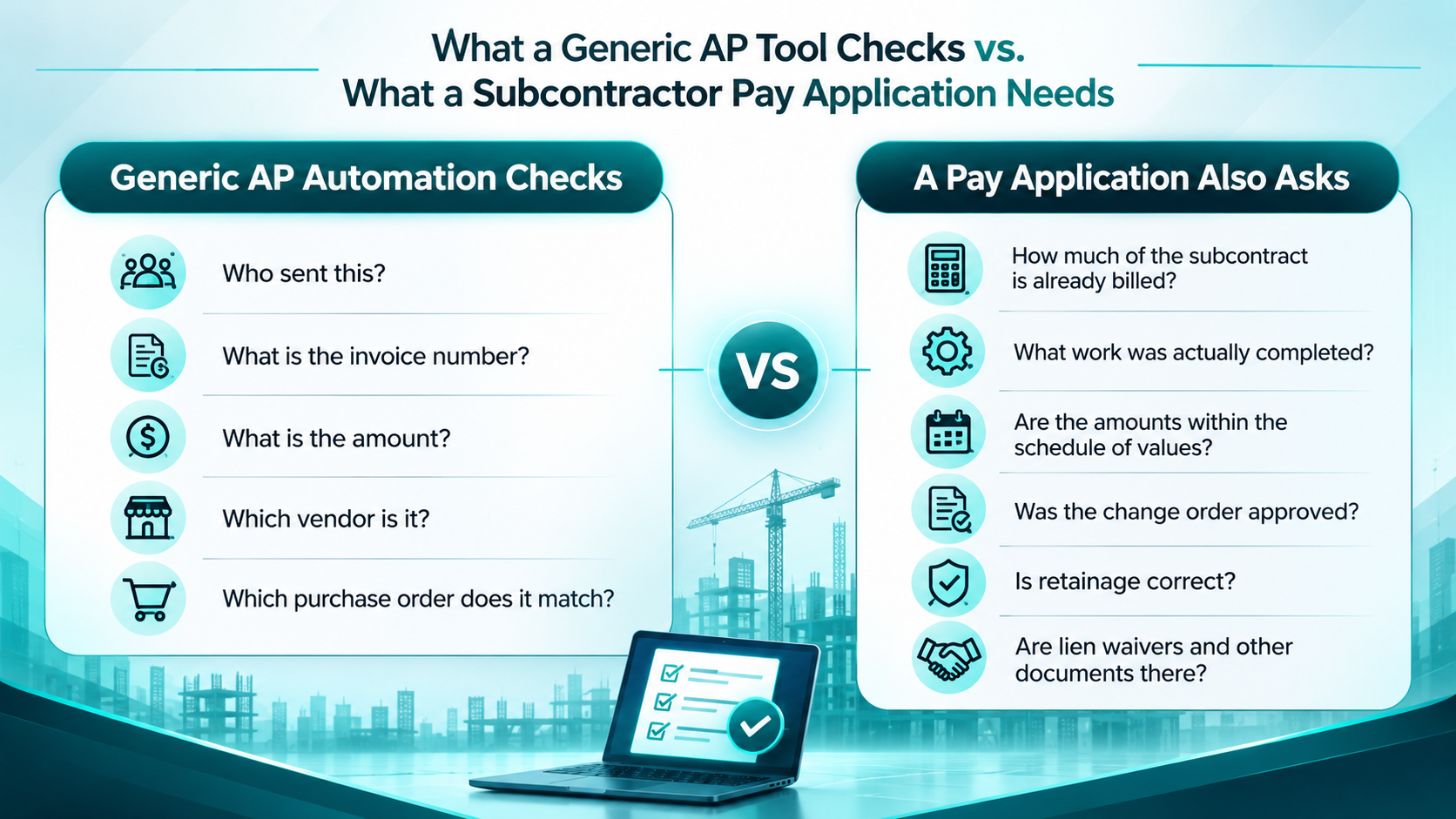
A typical accounts payable automation platform is good at questions such as: Who sent this? What is the invoice number? What is the amount? Which vendor is it? Which purchase order does it match?

A construction finance team has a longer list. How much of the subcontract has already been billed? What work was actually completed? Are the current amounts within the schedule of values? Was that change order approved? Is retainage correct? Are the required waivers and supporting documents there? Does the amount agree with the project record?
ALT TEXT

That is the gap. Generic AP automation can automate the document. Construction AP automation has to understand the job.

And that distinction matters more as contractors move toward AI-powered finance workflows.

A Pay Application Is a Financial Claim, Not Just an Invoice

Think about what sits behind a monthly subcontractor pay application. A subcontractor is not simply saying, “Here is my invoice for $250,000.” They are saying, in effect, “Based on our contract, the work completed this period, approved changes, previous billings, stored materials, and applicable retainage, this is the amount we are asking you to certify and pay.”

The document needs context from the project itself. The schedule of values matters. The subcontract matters. Prior applications matter. Change orders matter. Retainage matters. And, depending on the project, compliance documents such as lien waivers and certified payroll can matter too.

A documented subcontractor payment workflow lays out the process clearly: a pay application can move from receipt and PM review through lien-waiver verification, AP processing, and payment. The review itself includes checking completed work, contract value, change orders, retainage, prior payments, and supporting documentation.

Where Generic AP Automation Usually Stops

This is where many accounts payable automation solutions look impressive in a demo and less impressive when the first complicated pay app lands in the queue.

1. Accounts Payable Automation Software Can Read the Document, Not the Contract

OCR and document intelligence are useful. They can pull the vendor name, dates, amounts, line items, and other fields from a PDF. But extracting a number is different from deciding whether that number belongs on this month’s payment.

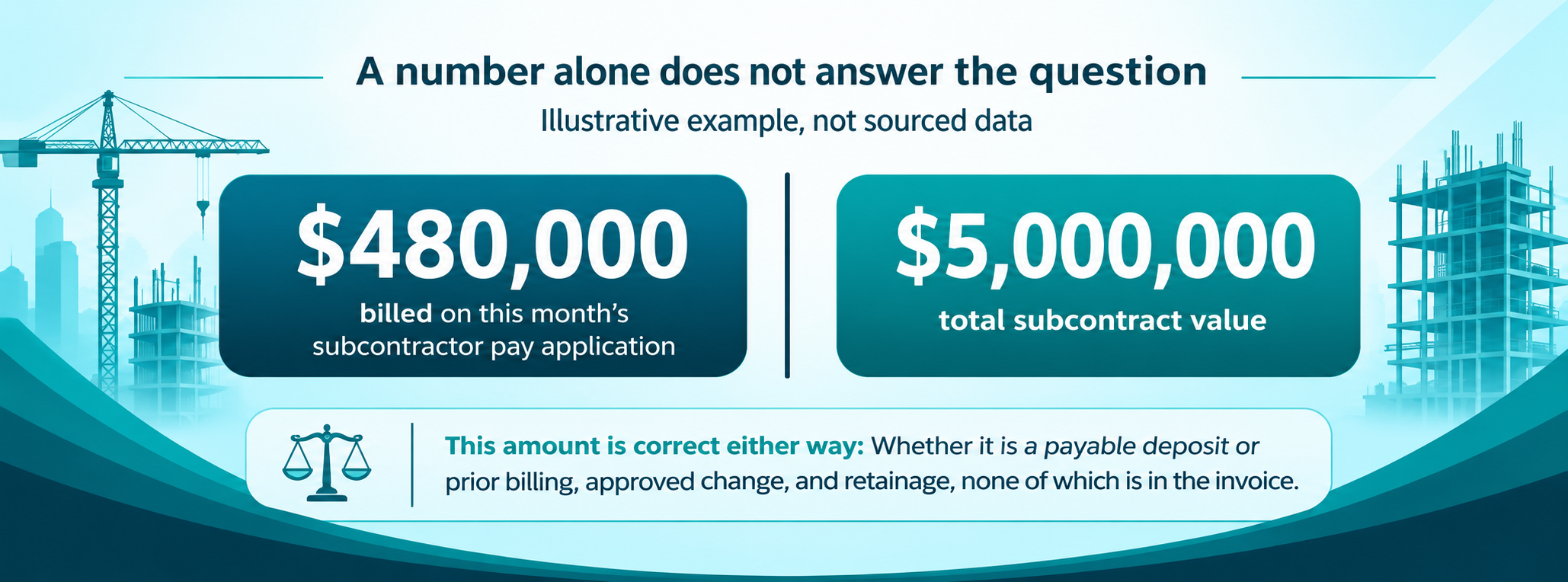
Suppose a subcontractor submits $480,000 against a $5 million contract. The automation reads the $480,000 correctly. That does not tell you whether the subcontractor has already billed $4.7 million, whether the remaining contract balance supports the claim, or whether the amount includes work covered by an unapproved change order.
ALT TEXT

2. Behind the Invoice Is a Schedule of Values

The schedule of values is one of the biggest reasons a subcontractor pay application is different from a standard invoice.

The AP team needs to see how the current application relates to the original contract and prior billing. A line for concrete, for example, is not just a $90,000 expense. It is part of a contract line with a history: scheduled value, previous applications, current progress, stored materials, retainage, and balance remaining.

Construction AP automation software needs to preserve that relationship instead of flattening everything into an invoice record.

3. Change Orders Can Change the Math

This is another place where a generic workflow can get uncomfortable quickly.

A subcontractor may bill against work that is legitimate but tied to a change order. The question is not simply whether the change exists. The question is whether it has been approved, how it changes contract value, and whether the pay application reflects the approved amount.

ProjectPro, for example, supports contract and change-order tracking alongside progress billing. Its product documentation describes tracking approved amounts, contract change orders, AIA applications, and schedules of values within the construction workflow.

4. Retainage Is Not a Footnote

Retainage can be easy to overlook when an AP system treats every document as a standard invoice.

In construction, the retainage rate can be tied to the contract and can affect the amount that is actually payable. It also becomes part of the financial picture that project managers, controllers, and executives need to track.

ProjectPro’s construction feature set includes retainage management in subcontract management, plus progress billing with AIA applications and schedules of values.

5. The Field May Know Something AP Does Not

Here is the part that often gets missed in conversations about AP automation.

A pay application is ultimately about work performed. The finance system may have the contract and the previous billing, but the project team may be the group that knows whether the claimed work is actually complete.

If the subcontractor says 80% of a scope is complete and the project team says it is closer to 65%, the automation should not quietly pick a number. It should surface the exception and route it to the person responsible for resolving it.

Automating data entry is not the same as automating a controlled workflow.

The construction AP workflow has to connect project progress, contract records, compliance, and payment approval.

What Construction AP Automation Software Should Actually Do

The answer is not “more AI.” It is better context.

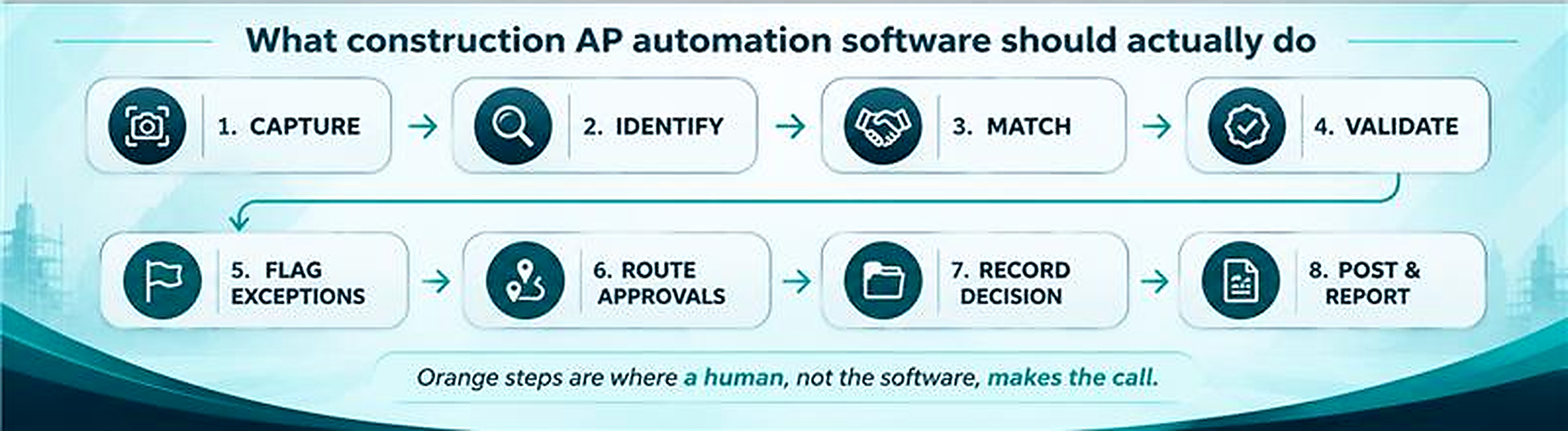
  1. Capture: Bring the pay application and supporting documents into a controlled workflow.
  2. Identify: Recognize the subcontractor, project, contract, billing period, and relevant documents.
  3. Match: Compare the application with the subcontract, schedule of values, prior billing, purchase orders or commitments, and approved changes.
  4. Validate: Check amounts, retainage, progress, required documentation, and configured business rules.
  5. Flag exceptions: Stop the workflow when something needs a PM, AP, controller, or other human decision.
  6. Route approvals: Send the right exception or approval to the person who owns it.
  7. Record the decision: Keep the approved amount, adjustments, supporting documents, and audit trail together.
  8. Post and report: Carry the approved financial information into the ERP and make it available for job costing, WIP, cash flow, and reporting.
ALT TEXT

This Is Where AI Can Help. But AI Needs the Right System Behind It.

Microsoft’s current Business Central AI capabilities show where AP automation is heading. The Payables Agent can monitor a designated mailbox, extract invoice information, identify vendors, suggest invoice details, and create purchase invoice drafts for review. It can also match invoices with purchase orders and receipts in supported scenarios.

What makes that useful is where it operates: the agent works inside Business Central, where vendor, purchasing, accounting, and business-rule context already exists. Microsoft also keeps a human review step in the workflow, including review of suggested invoice details before finalization.

For construction, the same principle applies. An AI model can read a pay application. The real value comes when the workflow can also reach the project data needed to decide what the application means.

Where ProjectPro Fits

ProjectPro is built on Microsoft Dynamics 365 Business Central and is designed specifically for construction firms. Its construction capabilities include subcontract management, retainage, progress billing, AIA applications, schedules of values, contract and change-order management, and project cost visibility.

That matters because AP does not operate in isolation on a construction project. The same project data influences commitments, job costs, billing, change orders, WIP, and cash flow.

ProjectPro’s role-based model also gives finance and project teams different views into the same underlying business information. Finance sees job costs, WIP, retainage, and cash flow. Project managers work with committed costs, change orders, budgets, and billing.

For a subcontractor pay application, that connected context is the point. The AP team should not have to reconstruct the project every time a payment request arrives.

And This Is Where NCIP Can Take It Further

NCIP is built around a simple idea: AI should work with the construction operation, not sit beside it.

For AP, that could mean an AI teammate that helps review incoming subcontractor pay applications against the records already sitting in the construction platform. It can help identify missing information, surface unusual amounts, compare billing with approved contract changes, flag exceptions, and prepare the work for human review.

The important word is “help.” A payment decision still needs the right people, permissions, controls, and audit trail. The AI should make the review faster and more consistent, not make an unexplained payment decision on its own.

This lines up with Microsoft’s own agent model for Business Central: agents are designed to automate specific processes while keeping the work transparent, reviewable, and within defined permissions.

A Better Question to Ask When Evaluating AP Automation

Instead of asking, “Can this software read invoices?” ask a harder question:

A BETTER QUESTION

Can this workflow understand why this payment is due, what supports it, and what should happen if something does not match?

That question will quickly separate a document-processing tool from a construction-ready AP workflow.

Look at a real pay application from one of your active jobs. Then trace the information behind it. Where is the subcontract? Where are the approved change orders? Where is the schedule of values? Where is prior billing? Where is retainage? Where does the PM confirm progress? Where are compliance documents stored? And after approval, where does the final amount land?

If the answer is six systems, three spreadsheets, email, and someone’s memory, the problem is bigger than invoice capture.

The Goal Is Not Just Faster AP

Faster invoice processing sounds good. But construction finance teams need more than speed.

They need confidence that the amount being processed belongs to the right project, the right contract, the right billing period, and the right approval path.

They need project managers and AP teams looking at the same numbers. They need finance to see the impact on job costs and cash flow. They need a clear record when an application is adjusted or held.

That is what construction accounts payable automation should ultimately deliver: fewer manual checks where software can handle them, better visibility where people need to make decisions, and a financial record that stays connected to the job.

FAQs

A subcontractor pay application is a periodic request for payment based on work completed and other contractually eligible amounts. It can include a schedule of values, prior billing, current progress, stored materials, change orders, and retainage.

An invoice generally asks for payment for a defined amount. A subcontractor pay application is usually tied to project progress and contract terms. The amount may need to be reviewed against the schedule of values, prior applications, approved changes, retainage, and project progress before it becomes payable.

At minimum, the workflow should be able to connect the application to the project and subcontract, check prior billing and contract value, account for approved change orders and retainage, verify required supporting documents, route exceptions, and maintain an approval trail.

AI can assist with document extraction, matching, anomaly detection, workflow routing, and preparation for review. It should operate within defined permissions and business rules, with human review for decisions that require project or financial judgment.

ProjectPro connects construction finance and project workflows on Microsoft Dynamics 365 Business Central. Its capabilities include subcontract management, retainage, progress billing, AIA applications, schedules of values, contract and change-order management, and project cost visibility.

ProjectPro exists for exactly this kind of problem. It connects construction AP, subcontractors, job costs, contracts, billing, and project data in one Microsoft-based platform, so a pay application does not have to be reconstructed by hand every time it lands in the queue.

See how ProjectPro handles subcontractor pay applications. Book a 20 minute walkthrough →

Evaluating Construction ERPs in KSA: Connecting Project Accounting to ZATCA Phase 2

For a Saudi contractor, choosing an ERP is not simply an accounting software decision.

Consider a contractor in Riyadh preparing for another ZATCA e-invoicing integration requirement. Project costs are tracked in one system, retention in another, subcontract commitments in spreadsheets, and payroll sits separately from project accounting.

The company may still be able to produce an invoice. The harder question is whether that invoice reflects what actually happened on the project. That is why ZATCA compliance should not be treated as a feature added after selecting an ERP.

For construction companies, VAT, e-invoicing, payroll, job costing, commitments, billing, and project reporting need to work as one financial workflow. The right construction ERP should make compliance part of how project transactions are captured, approved, billed, and reported.

Generic Accounting Software Can Calculate VAT. Construction ERP Has to Explain the Project.

A standard accounting system can calculate VAT on an invoice. Construction billing requires considerably more context. A contractor may invoice against:

  • Progress or milestone payments
  • Advance payments
  • Retention
  • Approved variations and change orders
  • Subcontractor costs
  • Materials and equipment
  • Labor and project expenses
  • Multiple jobs or sub-jobs under the same contract

This matters because construction VAT does not operate as an isolated invoice calculation.

ZATCA’s construction-sector VAT guidance treats construction services as a continuous supply of services and sets specific VAT timing rules for progressive payments. Where contracts specify payment due dates at milestones, VAT becomes payable at the due date or when payment is received, whichever comes first. For other progress payments, the relevant trigger is the invoice date or actual payment date, whichever comes first. ZATCA VAT guideline for the contracting sector

The same guidance addresses retention payments directly. It states that retention does not change these rules and that VAT remains due based on the full amount invoiced or the full amount due at the applicable milestone.

That creates an important ERP requirement. The invoice should not exist as an isolated accounting document. It should remain connected to the project contract, billing record, retention, change order, cost transactions, and customer balance. This is where a construction ERP has an advantage over a generic accounting setup. The system can preserve the relationship between the project event and the financial transaction.

ZATCA itself identifies its contracting-sector VAT guideline as covering construction services, tax due dates, tax invoice issuance, and other sector-specific VAT considerations.

What Does ZATCA-Ready Actually Mean for a Construction ERP?

“ZATCA compliant” should not be treated as a checkbox during an ERP evaluation. Saudi Arabia’s e-invoicing program has two phases.

  • Phase 1, the Generation Phase, requires taxpayers to generate and store compliant electronic invoices.
  • Phase 2, the Integration Phase, introduces additional technical and business requirements and integration with ZATCA systems. Phase 2 has been rolled out in waves since January 1, 2023.

ZATCA’s current technical requirements include electronic invoice data requirements and an XML implementation standard defining the technical syntax and business content of electronic invoices.

For a construction ERP, the important question is therefore not simply: “Does the software support ZATCA e-invoicing?”

Ask instead: “Where does the ZATCA-compliant invoice process begin inside the project workflow?”

A construction ERP should let your team trace the path from the project transaction to billing, VAT, invoice, accounting entry, and customer balance without rebuilding the information manually. That is the difference between an ERP that simply produces a compliant invoice and one that keeps the underlying project financial data connected.

ZATCA’s Latest Wave Shows Why Waiting for the Notification Is Risky

ZATCA continues to expand Phase 2 through taxpayer-specific waves. In its July 24, 2026 announcement for Wave 25, ZATCA stated that the wave covers taxpayers whose VAT-subject revenues exceeded SAR 187,500 during 2022, 2023, 2024, or 2025. Targeted taxpayers must integrate their e-invoicing solutions with the Fatoora platform by February 1, 2027. ZATCA Wave 25 announcement

ZATCA also states that subsequent Phase 2 waves will be communicated to targeted taxpayers at least six months before their integration date.

For contractors, this makes construction ERP readiness a broader question than simply meeting an integration deadline. If your construction ERP software cannot clearly connect project billing, VAT, customer balances, and supporting project transactions today, adding an e-invoicing connection may solve the compliance output without solving the underlying accounting problem.

Payroll Should Feed Project Cost, Not Sit Beside It

Payroll is another area where construction companies need to think beyond compliance. A contractor may have:

  • Direct employees
  • Expatriate workers
  • Overtime and allowances
  • Employees working across multiple projects
  • Site-based labor
  • Subcontract labor
  • Different cost codes or activities

The accounting question is straightforward: What did this labor actually cost the project? That requires more than processing payroll.

ALT TEXT

Timesheets, labor rates, overtime, allowances, and other relevant costs should flow into project accounting so project managers and finance teams can see actual labor cost against budget. WPS and GOSI-related responsibilities should also be considered separately from Saudization or Nitaqat requirements. They are different areas of Saudi workforce and compliance management and should not be treated as one payroll feature.

During an ERP evaluation, ask for a demonstration of the complete workflow:

Employee → Time → Project → Cost Code → Payroll → Project Cost → Margin

If the process depends on exporting spreadsheets and manually reallocating labor costs, the ERP is not giving project accounting the information it needs.

Compliance Does Not Protect a Project That is Already Losing Money

A contractor can produce compliant invoices and still lose money on a project. Why? Because compliance tells you whether financial transactions are being processed according to requirements. It does not automatically tell you whether the project is commercially healthy.

A project can lose margin because:

  • Subcontract commitments were not captured early.
  • Labor was charged to the wrong project.
  • A variation was approved but not billed.
  • Retention was not forecast correctly.
  • Actual costs exceeded the original budget.
  • Procurement costs increased.
  • Project managers cannot see committed costs before they become actual expenses.

This is why the most important ERP workflow for a contractor may look like this:

Contract → Budget → Commitment → Cost → Progress Billing → VAT → Invoice → Receivable → Project Margin

Every step should remain connected. If finance can see the invoice but cannot trace it back to the project event, the system is incomplete from a contractor’s perspective. If project management can see costs but cannot connect them to billing and margin, the same problem exists in reverse.

What Should Saudi Contractors Evaluate Before Choosing an ERP?

Instead of comparing feature counts, test the ERP against an actual construction workflow.

1. Project billing

Can the system handle progress billing, advance payments, retention, and approved variations directly from the project?

2. VAT traceability

Can your finance team trace the VAT amount on an invoice back to the underlying project transaction?

3. ZATCA integration

Where does the ZATCA/Fatoora process sit in the invoice workflow? Ask the vendor to demonstrate the actual flow rather than simply confirming that “ZATCA is supported.”

4. Payroll and labor costing

Can payroll and timesheet information be allocated to the correct project, task, or cost code?

5. Commitments

Can the project team see approved subcontract and purchasing commitments before those costs become actual expenses?

6. Project margin

Can management see budget, committed cost, actual cost, forecast, revenue, and projected margin without building a separate spreadsheet?

7. Audit trail

Can a reported amount be traced back to its originating transaction? This final test matters more than a long feature list.

A construction ERP should make it easier to answer: Where did this number come from?
And then: How did it affect the project?

Where ProjectPro Fits

ProjectPro is an AI-powered construction ERP built on Microsoft Dynamics 365 Business Central, with Microsoft 365 Copilot as the intelligence layer.

ALT TEXT

ALT TEXT

Its construction-focused capabilities cover project accounting, job costing, billing, commitments, and financial management within one platform.

For Saudi contractors evaluating ProjectPro, the implementation discussion should go beyond the product demonstration. The right questions include:

  • Saudi VAT configuration
  • ZATCA/Fatoora integration approach
  • Project billing and retention workflows
  • Payroll and workforce integrations
  • Local reporting requirements
  • Data and implementation scope
  • Integration requirements with existing systems

The real test is whether the ERP can run your actual construction workflow without creating a parallel accounting process in spreadsheets.

The Netsmartz View: Start With the Project, Not the Compliance Checklist

ZATCA compliance should be treated as an ERP architecture test, not a separate finance project. Start with one real project. Take its contract value, budget, commitments, costs, progress billing, retention, variations, labor, VAT, invoice, receivable, and projected margin.

Then ask the vendor to connect the entire chain in the construction ERP. The result should be a clear financial trail from the project transaction to the final margin, without duplicate entries, disconnected spreadsheets, or manual reconciliation between project and finance teams.

For Saudi contractors, that is the standard to apply before implementation:

Can the system keep the project financially traceable from contract to final margin while meeting the country’s tax and e-invoicing requirements?

That question will tell you more about ERP readiness than a feature checklist alone.

See How ProjectPro Fits Your Construction Workflow

Don’t evaluate an ERP from a feature checklist. Test your actual contract, billing, retention, commitments, labor costs, VAT, and reporting workflow.

[Book a ProjectPro Workflow Assessment →]

Netsmartz can help you assess the integrations, data flows, construction-specific requirements, and implementation considerations that need to be addressed before moving forward.

FAQs

Look beyond general accounting and VAT functionality. A construction ERP should connect project contracts, budgets, commitments, costs, progress billing, retention, VAT, receivables, payroll-related project costs, and project margin.

The key test is whether finance and project teams can trace a financial result back to the underlying project transaction.

For Wave 25, announced on July 24, 2026, ZATCA identified taxpayers whose VAT-subject revenues exceeded SAR 187,500 during any of 2022, 2023, 2024, or 2025. Targeted taxpayers must integrate their e-invoicing solutions with Fatoora by February 1, 2027.

However, contractors should check their own ZATCA notification and applicable wave rather than assuming that Wave 25 applies to them.

Technically, an external e-invoicing solution can be part of an organization’s architecture. The more important question is whether the integration preserves the connection between project billing, VAT, customer balances, and supporting transactions.

If teams still need spreadsheets to reconcile project billing and accounting after adding e-invoicing, the compliance gap may be addressed while the project-accounting problem remains.

Not necessarily. The important requirement is that relevant payroll and timesheet information can flow reliably into project costing. A contractor should be able to determine the actual labor cost associated with a project, activity, or cost code without repeated manual allocation.

Use an actual project rather than a generic product demonstration.

Test one complete workflow: Contract → Budget → Commitment → Cost → Progress Billing → VAT → Invoice → Receivable → Project Margin

Then test exceptions such as retention, variations, subcontract costs, and labor allocation. If the ERP can handle the workflow with clear traceability and limited manual reconciliation, you have a much stronger basis for evaluating implementation readiness.

CFMA 2026 Member