
Ch 02 – Project Setup
Contents
PROJECT SETUP
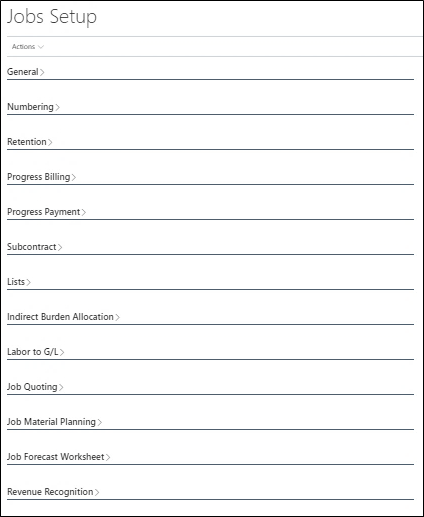
The Project Setup page consists of different setups under different fast tabs as shown in the screenshot. Although it is likely that this information will be set up for you during the initial database configuration and set up, you may need to add or adjust this information as your company grows and changes.
Search for “Project Setup” from the search icon and click on the relevant option. The below page will open showing all fast tabs.
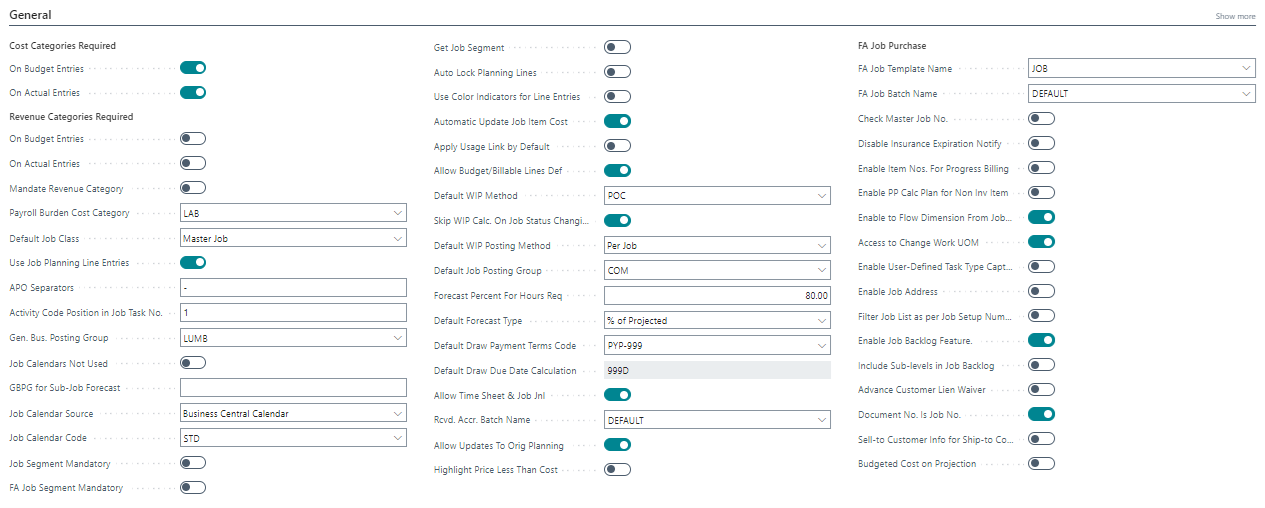
General Fast Tab
| FIELDS | DESCRIPTION |
| Cost Categories Required | The “Cost Categories” are strongly recommended for denoting a cost entry to be as “Labor, Equipment, Subcontract, Materials, etc.” as this type of entry does not exist in Standard Business Central. Toggling this option ON will mandate Cost Categories on Budget Entries, Actual Entries, or both. |
| Revenue Categories Required | Toggling this option ON will require Revenue Categories on Budget Entries, Actual Entries, or both. This requirement is typically off. |
| Payroll Burden Cost Category | Specify the default Cost Category to be used when applying Payroll Burden. |
| Default Project Class | Specify the default (optional) project Class to be updated when creating a new Project such as Master project, Sub project, Change Order, etc. |
| Use Project Planning Line Entries | Enable this field to flow the same G/L Account No. from Project Planning Lines to Sales Document via Progress Billings. Disabling this, the system will follow the same rule to flow G/L Account No. based on the Project Posting Group selected on the Project Task Lines or Project card. |
| APO Separators | Specify the symbol that will be used to separate the Activity, Process, Operation and Section task codes that make up the “Project Task No.”. Typically, we recommend using a dash (-). |
| Activity Code Position in Project Task No. | Specifies the position of the Activity Code in a Project Task Number, which is usually at the 1st position. |
| Gen. Bus. Posting Group | Specifies default General Business Posting Group to be updated on the Project card which will then get populated to Sales Invoice/ Purchase Invoice Document, overriding the Vendor and Customer’s General Business Posting Group. |
| Project Calendar Not Used | Enable this field when Project Calendars are not to be used. Recommend using Business Central default Calendar. |
| GBPG for Sub-Level Project Forecast | Specifies the General Business Posting Group for the Sub-level Project to be included in Project Forecast Worksheet posting (when done from Master Project), Percentage of Completion Report and Project Profit Analysis Report. |
| Project Calendar Source | Choose the source of the calendar to be as Standard Business Central Calendar or Project Calendar. This field is recommended to be Business Central Calendar. |
| Project Calendar Code | Select the Calendar Code for Project as per the calendar source selected. Usually start with a standard calendar for workdays. |
| Project Segment Mandatory | Specifies if the Project Segment is mandatory for every transaction related to Project. Segments are another field that can relate “Budget and Billable Project Planning Lines” independent of the Project Task No. field. Initially, “Segment” was thought of as the “Bid Item” reference. |
| FA Project Segment Mandatory | Specifies that FA Project Segment is mandatory on Purchase Documents for Project and FA related entries together. Where the FA is “Fixed Asset”. |
| Get Project Segment | Specifies that the system will carry the Segment from Master Project to Sub-Levels Project. |
| Auto Lock Planning Lines | Enable this to auto lock the planning lines when converting the Project Quote to Project. This will add all the planning lines populated from Project Quote to “Project Planning Lines (Locked)” page. This will then be visible as Locked (Cost) under Project Budget/Billable fast tab on Project card. This represents the “Original” budget and billable “Contract” values when the project was established. |
| Use Color Indicators for Line Entries | Enable to highlight the amount in Red on Purchase Order or Subcontract lines when it exceeds the cost defined on respective Project Planning Lines. This will also highlight the “Actual Cost” and the “Invoiced Price” amounts on the Project Task Lines, when they get exceeded by the “Budgeted Cost” and the “Billable Price”, respectively. |
| Automatic Update Project Item Cost | Specifies that cost changes are automatically adjusted each time the “Adjust Cost – Item Entries” Batch Project is run. The adjustment process and its results are the same as when you run the “Update Project Item Cost” Batch Project. Recommended to be “ON”. |
| Apply Usage Link by Default | By default, the ‘Project Ledger Entries’ are linked to ‘Project Planning Lines’. If enabled, this will apply to all new Project created. Recommended to be “OFF” and can used on a Project-by-Project basis. This is a way of knowing on a specific project planning line what the quantities are in relation to the project ledger entries of actual purchases. Because of the way many budgets are based on value of a Project Task instead of a specific Item, usually the “Apply Usage Link” is OFF. This feature would be ON for “Time & Material” Project. |
| Allow Budget/Billable Line Def. | By default, Project Planning Lines will be of type “Both Budget and Billable”. If enabled, this will apply to all new Project created. Recommended to be “OFF” and can used on a Project-by-Project basis. |
| Default WIP Method | Specifies the default method to be used for calculating work in process (WIP). It is applied whenever you create a new Project, but you can modify the value on the Project card. In ProjectPro it is kept as POC, but ProjectPro does not use the Business Central “WIP Method”. |
| Skip WIP Calc. On Project Status Changing | If enabled, the WIP message will not appear after changing the Status of the Project under the “Constant/Manager” fast tab on the Project Card. Please note that WIP messages will only skip if no WIP Entries exist for the same project. |
| Default WIP Posting Method | Specifies how the default WIP method is to be applied when posting Work in Process (WIP) to the general ledger. By default, it is applied “Per Project” but can be changed to “Per Project Ledger Entry”. |
| Default Project Posting Group | Specifies the default posting group to be applied when you create a new Project. This group is used whenever you create a Project, but you can modify the value on the Project card. |
| Logo Position on Document | |
| Specifies the position of your company logo on business letters and documents. It can be set to Left, Right, Centre, or No Logo. | |
| Forecast Percentage for Hours Req. | Indicates at what percent of your budget should trigger hours to finish by project managers. Example, If the Forecast Percentage is set at 80%, when actual cost exceeds 80% of budget, then the hours to finish field is required to be filled in on the Project Forecast Worksheet. |
| Default Forecast Type | Select the type of Project Forecast calculations based on % of Budget or % of Projected. % of Projected is the recommended option, if using the Project Forecast tool. |
| Default Draw Payment Terms Code | Specifies the default payment terms to be set for vendors as a default when using “Pay when Paid” business process. The “Pay when Paid” is the term of paying your vendors when your customer pays you. This is typically set in ProjectPro with the one set to “999D” due date calculation. This will get updated on the purchase documents when a Draw No. is selected. |
| Default Draw Due Date Calculation | Specifies default due date calculation based on Payment Terms Code selected above. |
| Allow Time Sheet & Project Jnl. | This enables a User to enter Resource’s time either directly through the Project Journal or employee can enter their own Timesheet if their Resource Card is set to “Allow Time Sheet Entry”. |
| Rcvd. Accr. Batch Name | Specifies the Rcvd. Accr. Batch Name. This the Journal Batch to be used to create Received Not Invoiced items to “Accrue Costs at Month End”. |
| Allow Updates to Orig. Planning | This will allow the QTY & Rate on the Planning Lines to be changed – even after the Purchase Order has been generated. |
| Highlight Prices Less Than Cost | Will highlight the planning lines in red, italicized font to indicate that your price is less than your cost. |
| FA Project Template Name | Specifies the Project journal template to purchase FA (Fixed Assets) with Project. |
| FA Project Batch Name | Specifies the Project journal batch based on the template selected on prior field. |
| Check Master Project No. | If enabled, when creating a Sub-Project from a Master Project card, only Project Task Lines from the Master Project will be available to copy over. |
| Disable Insurance Expiration Notify | Toggle “on” or “off” to enable notification of vendor insurance expiration. |
| Enable Item No. For Progress Billing | Toggling it “on” means that in Progress Billing, type Item will be updated in the line instead of the G/L Account no. Toggling it “off” means that in Progress Billing, type G/L will be updated in the lines from Project Posting Setup. |
| Enable PP Calc Plan for Non-Inv. Item | Toggle it “on” or “off” based on whether you want to include noninventory items in the PP Calculate Plan function in Requisition Worksheet. |
| Enable to Flow Dimension from Project Card | Toggle it “on” or “off” based on whether you want to update the dimensions from Project card or from default General ledger setup. |
| Access to Change Work UOM | Specifies if user can change the Work UOM on Project Task Lines having Project Ledger Entries associated with it. |
| Enable User-Defined Task Type Caption | Allows them to use their own naming convention for Project Tasks, i.e., APOS namely “Activities”, “Process”, “Operations”, and “Section”. This is a company-wide naming of the Project Tasks levels. |
| Enable Project Address | Specifies that the address from the Project Card will be the Ship to Address in Purchase Order. |
| Enable Project Backlog Feature | If enabled, the closing of “Parent” or “Master” Project will be dependent upon whether all its sub-level Project are closed prior. The user will be alerted if there exists “Open” sub-level Project, preventing the closing until all sub-level Project are set to “Completed”. Note: The “Manager Status” of the project must be set to “Running”, for it to be included in the open project backlog calculations. |
| Include Sub-levels in Project Backlog | If enabled, the Master Project will show combined value (Master + Sub-Levels) under the “Open Project Backlog” column on the Project list, while the sub-levels will be shown with their individual Backlog values as well. Note: The “Manager Status” of the project must be set to “Running”, for it to be included in the open project backlog calculations. |
| Advance Customer Lien Waiver | Enable this feature to use advance level of Customer Lien Waivers. When set to True, it will disable the two fields on Customer Ledger Entries, “Lien Waiver Amount” and “Lien Waiver Payment”. Then the reporting features will track any “Open” and unpaid customer invoices for reporting on future Customer Lien Waivers. |
| Document No. Is Project No. | Specifies that the Project number is also the document number in the ledger entries posted for the Project. |
| Sell-to Customer Info for Ship-to Code | If enabled, the Sell-to Customer information will be set to default for Ship-to Code/details on General fast tab of the Project card. By default, the Ship-to Code/details gets updated with Bill-to Customer information. |
| Budgeted Cost on Projection | Enabling this Boolean will check the Project Planning Lines with Line Type not equal to Billable and picks the Total Cost LCY on Projections fast tab into the field Budget Total Cost under Actual column on Project Card. |
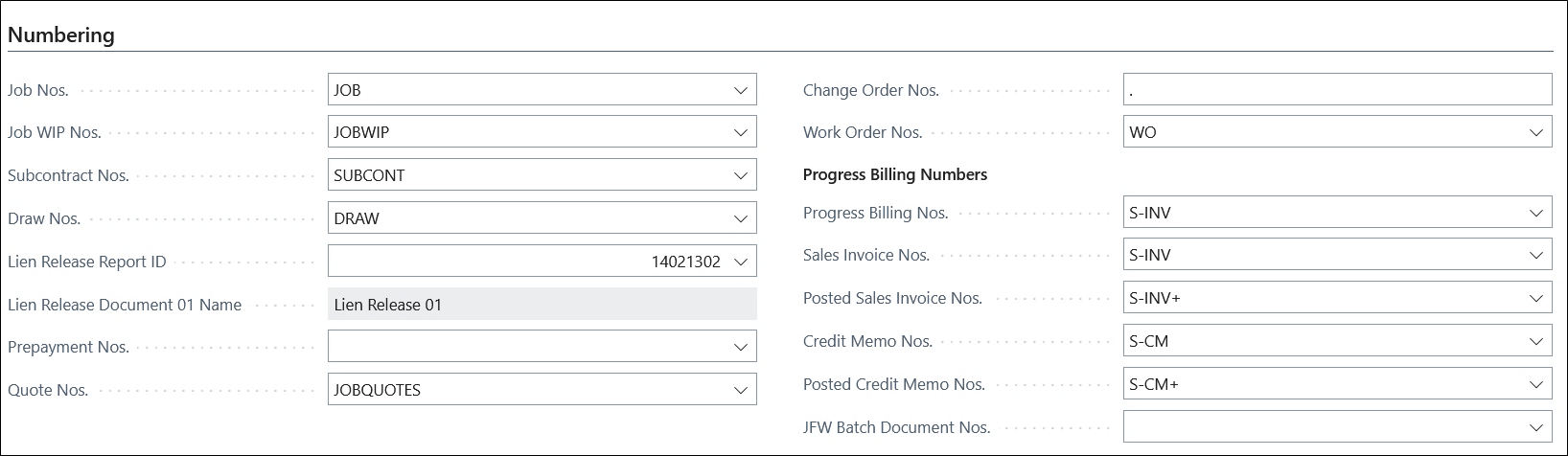
Numbering Fast Tab
| FIELDS | DESCRIPTION |
| Project Nos | Specifies the code for the Project number series which will be used in Project. |
| Project WIP Nos. | Specifies the code for the Project WIP number series which will be used in Project WIP. |
| Subcontract Nos. | Specifies the code for the Subcontract number series which will be used in Subcontracts. |
| Draw Nos. | Specifies the code for the Draw number series that will be used in Draw. |
| Lien Release Report ID | Enter the report number for the Lien Release Report. This is the Vendor (Subcontractor) Lien Release document. |
| Lien Release Document 01 Name | The Lien Release Report name displays from the ID entered. |
| Prepayment Nos. | Enter the Prepayment No. series CODE. See “No. Series” Table. |
| Quote Nos. | Enter the Quote No. series CODE. See “No. Series” Table. |
| Change Order Nos. | Specifies the code for the number series that will be used assign numbers to Change Orders created from Master Project. To see the number series that have been setup in the No. Series table. |
| Work Order Nos. | Enter the Work Order No. series code. |
| Progress Billing Nos. | Enter the Progress Billing No. series code. Most often the Progress Billing is the Master Project No. |
| Sales Invoice Nos. | Enter the Sales Invoice No. series code for Progress Billing |
| Posted Sales Invoice Nos. | Enter the Posted Sales Invoice No. series code for Progress Billing |
| Credit Memo Nos. | Enter the Credit Memo No. series code for Progress Billing |
| Posted Credit Memo Nos. | Enter the Posted Credit Memo No. series code for Progress Billing |
| JFW Batch Document Nos | Specifies the number series used for Batch Document Nos. on project forecast worksheet on running “Batch Posting for Project Forecast Worksheets”. |
Retention Fast Tab
Once you have determined if your company will be using retainage receivables and /or payables, you must establish the Sales Retention and Purchase Retention Periods.

| FIELDS | DESCRIPTION | ||||||
| Sales Retention Period | Represents the aging of the retention portion of the receivable. Example: The ‘1Y’ means one year from the document date for establishing retention receivable due dates. | ||||||
| Purchase Retention Period | Represents the due date for the retainage portion of the vendor invoice. | ||||||
| Retention Receivable Ledger | Select the Retention Ledger for Retention Receivables. This is the standard selection for retention receivable tracking. Most set as “Retention”. | ||||||
| Retention Payable Ledger | Select the Retention Ledger for Retention Payables. This is the standard selection for retention payable tracking. Most set as “Retention”. | ||||||
| Calc Receivable Retention Before Tax | Check this box if you prefer to have retention receivables calculated before tax is assessed. | ||||||
| A/R Retention Calc Method | Out of the options available select the one that aligns best with your business practices. Option 3 is the suggested option for ProjectPro.
|
||||||
| A/P Retention Calc Method | Out of the options available select the one that aligns best with your business practices. Option 3 is the suggested option for ProjectPro.
|
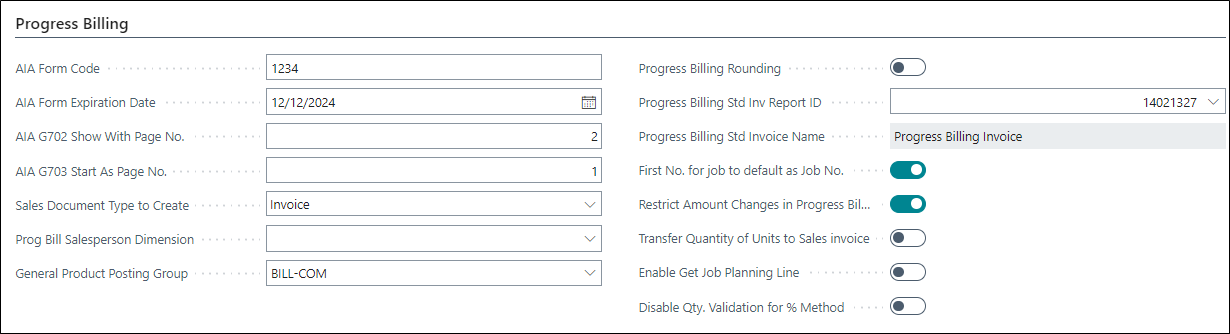
Progress Billing Fast Tab
| FIELDS | DESCRIPTION |
| AIA Form Code | Enter your AIA (American Institute of Architects) license (subscription no.) to print G702 and G703 pages. |
| AIA Form Expiration Date | Enter your AIA license (subscription no.) expiration date. |
| AIA G702 Show with Page No. | Enter the page number if desired on the AIA G702 report. Usually starts with 1. |
| AIA G703 Start as Page No. | Enter the start page number if desired on the AIA G703 report. Usually starts with 2. |
| Sales Document Type to Create | This is the setting for whether you want the progress billing to create either a Customer Sales Order or a Customer Sales Invoice. Usually this is set to “Customer Sales Invoice”. |
| Prog. Bill Salesperson Dimension | Specifies the default dimension for Salesperson on the Progress Billing. |
| General Product Posting Group | Sets a default General Product Posting Group that is used during the Customer Invoice process. If not required, then the Project Posting Group is used. |
| Progress Billing Rounding | Select this option if you would like to default on all progress billing sales amounts to nearest whole dollar. This can also be selected on progress billings for individual billings. |
| Progress Billing Std Inv. Report ID | Enter the report number for a standard Invoice. The ProjectPro default report number is 14021327 |
| Progress Billing Std Inv. Report Name | Automatically updates the name of the report entered above. |
| First No. For Project to Default as Project No. | Enable to have the Project No. match your Progress Billing No. |
| Restrict Amount Changes in Progress Billing Invoice | |
| Transfer Quantity of Units to Sales Invoice | If enabled and the Billable Planning line is set to Billing Method of “Units”, then Quantity being billed is transferred to the Sales Document. If disabled, then only the Quantity of 1 is transferred. |
| Enable Get Project Planning Line | Enable to use “Get Project Planning Lines” function on the progress billing form. This feature will allow a user to select one or more Billable Project Planning Lines for the progress billing. Enabling this feature will disable the standard “Get Billings” function on the progress billing. |
| Disable Qty. Validation for % Method | Specifies if the user can put Quantity more than 1 on billable project planning lines when “Progress Billing Method = %”. |
Progress Payment Fast Tab

| FIELDS | DESCRIPTION |
| Purchase Document Type to Create | This is the setting for whether you want the progress payment to create either a Vendor Purchase Order or a Vendor Purchase Invoice. |
| Prog. Payment Purchaser Dimension | Default dimension to be taken for Purchaser in case of Progress Payment |
| General Product Posting Group | Sets a default General Product Posting Group that is used during the Vendor Invoice process. |
| Progress Billing Rounding | Select this option if you would like all progress payment amounts to be rounded to the nearest whole dollar. |
| Progress Billing Std Inv. Report ID | Enter the report number for a standard Payment. The ProjectPro standard report is 14021342 |
| Progress Billing Std Inv. Report Name | Automatically updates the Name of The Report selected above. |
| Progress Payment Enable | Toggle to unable Progress Payment in Subcontract Order. |
Subcontract Fast Tab

| FIELDS | DESCRIPTION |
| Subcontract Default UOM | Select the default UOM for all subcontracts. |
| Subcontract Unit of UOM | Select the best suitable option for Subcontract use of UOM. |
| Un-apply Usage Link on Subcontract | Toggle this “ON” if you don’t want to use usage links related to Subcontracts. Recommend this be set to ON as most Project Planning Lines do not match the transactions with subcontractors. |
Lists Fast Tab
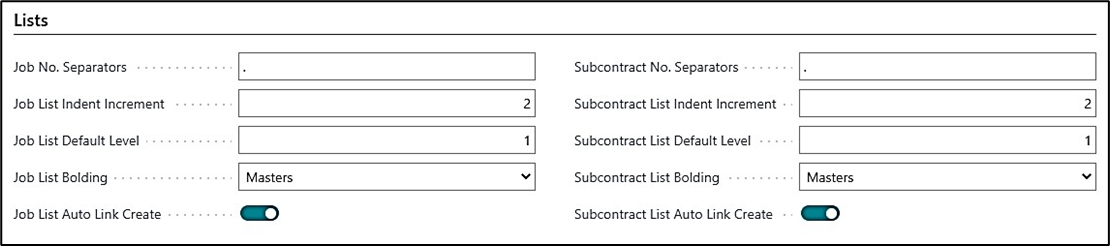
| FIELDS | DESCRIPTION |
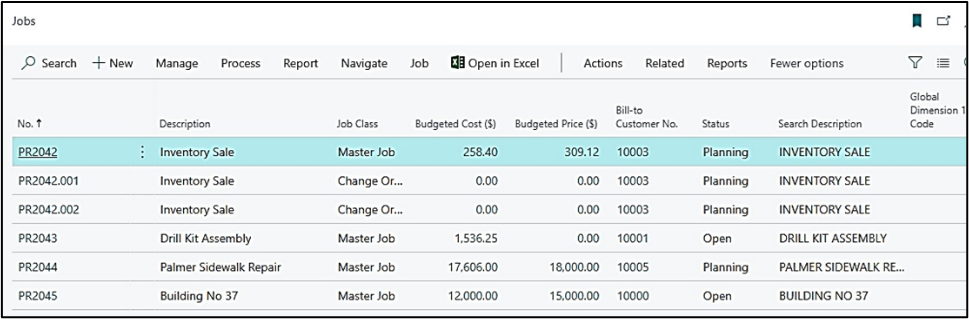
| Project No. Separators | Enter the symbol used to differentiate Master Project from Sub-Level Project. Example: if “.” is used, then 9600 (Master Project) and 9600.01 (Sub Project) |
| Project List Indent Increment | Specify the Increment for indentation when viewing Sub-Level Project from Master Project on Project List View. |
| Project List Default Level | Indicates how many levels of Project sub-levels you want the list to default too. See sample list below. |
 |
|
| Project List Bolding | Select what level will be displayed in bold when Project List is displayed. |
| Project List Auto Link Create | This should always be ON. This enables a Project list table to be populated with the links between the various Project classes. |
| Subcontract No. Separators | The symbol used to differentiate Master Subcontractor from Sub-Level. Example SUB101, SUB101.01, SUB101.02, etc. |
| Subcontract List Indent Increment | The view of indented sub-level Project under master Project. |
| Subcontract List Default Level | Indicates how many levels of subcontract sub-levels you want the list to default too. See sample list below. |
| Subcontract List Bolding | Indicates what level is displayed in bold, if any. |
| Subcontract List Auto Link Create | This should always be ON. This enables a subcontract list table to be populated with the links between the various Project classes. |
Indirect Burden Allocation Fast Tab
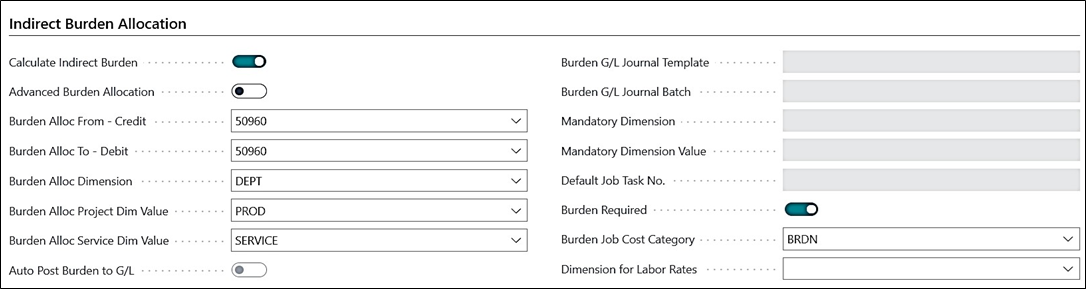
| FIELDS | DESCRIPTION |
| Calculate Indirect Burden | If enabled, the Indirect Burden will be calculated on the Project, based on Burden % defined on a specific Project Task Line. This will only update Project Ledger Entries. |
| Advanced Burden Allocation | If enabled, in addition to Indirect Burden, the Calculated Burden amount will also be updated on the G/L account through a Batch Project. |
| Burden Alloc. From – Credit | Select the credit G/L account for burden allocation. This G/L account is usually from the “Indirect Project Cost” section of your Chart of Accounts. |
| Burden Alloc. To – Debit | Select the debit G/L account for burden allocation. This G/L account is usually from the “Direct Project Cost” section of your Chart of Accounts. |
| Burden Alloc. Dimension | Select the dimension for burden allocation. This indicates which dimension is being used for burden. |
| Burden Alloc. Project Dim Value | Based on the dimension above, set the project dimension value |
| Burden Alloc. Service Dim Value | Based on the dimension above, set the service dimension value |
| Auto Post Burden | Specifies that you would like burden to be automatically posted to your G/L account when toggled “on” |
| Burden G/L Journal Template | Specifies the Burden G/L Journal Template to be used. This is only available if you are using Advanced Burden Allocations. |
| Burden G/L Journal Batch | Specifies the Burden G/L Journal Batch to be used. This is only available if you are using Advanced Burden Allocations. |
| Mandatory Dimension | Specifies the Dimension to be mandatory while processing the Subcontracts. This is only available if you are using Advanced Burden Allocations. |
| Mandatory Dimension Value | Specifies the Dimension Value to be mandatory while processing the Subcontracts. This is only available if you are using Advanced Burden Allocations. |
| Default Project Task No. | Specifies system should ask the Default Project Task No. while processing the Subcontract. This is only available if you are using Advanced Burden Allocations. |
| Burden Required | Turn ON if burden is required for all Project. |
| Burden Project Cost Category | Select the Project cost category for Burden calculations. |
| Dimension for Labor Rates | If you are requiring a dimension for Labor Rates, please specify here. |
Labor to G/L Fast Tab

| FIELDS | DESCRIPTION |
| Enable Project Labor to G/L | If enabled, the Labor entries posted from the Project Journal Batch (defined in the below setups) will flow to the defined General Journal Batch, where you can review the entries before posting them to G/L entries. |
| Auto Post Project Labor to G/L | Enable this to automatically post the Labor entries created on the Project Journal to G/L entries. |
| Labor Project Journal Template | Specifies the Project journal template name for creating the Project Labor entries that should be posted to G/L. |
| Labor Project Journal Batch | Specifies the Project journal batch name based on the Project Journal Template selected above for creating the Project Labor entries |
| Labor G/L Journal Template | Specifies the general journal template name to which the Project Labor entries will get populated from the Project Journal when posted. |
| Labor to Project Batch Name | Specifies the general journal batch name based on the G/L Journal template selected above to which the Project Labor entries will get populated from Project Journal when posted. |
| Project Labor Debit G/L | Specifies the debit G/L account for Project labor allocation to G/L entries. |
| Project Labor Offset G/L | Specifies the credit G/L account for Project labor allocation to G/L entries. |
| Project Cost Category for Labor Reversal | Specifies the Project Cost Category to be used for posting reversals of Project labor entries. |
Project Quoting Fast Tab

| FIELDS | DESCRIPTION |
| Use Default Tasks | If you want to use default Project task lines on each new Project and Project quote creation, select the required option. |
| Billing Project Task Nos. | Define the billing Project task number you would like to default on each Project. |
| Total Task Nos. | Define the Task to be used for totaling for the Project. |
| Item Quote Costs | Toggle it “on” or “off” to select cost from Quote cost field from Item Card |
| Labor Rate | Toggle it “on” or “off” to select Labor rate based on Project type for the type – Person as defined in Labor by Task page |
| Enable Resources in Gross Marg. Calc. | Specifies the system calculates the Markup% on Project Tasks for the Resource. |
| Enable Markup on JPL Cost Category | Specifies the Markup will be updated on the Project Planning Line based on the value or % specified on the Cost Category. |
| Lock Multi Markup Update on JPL | Specifies user can only update the Markup calculation on the Project Planning Line only once. |
Project Material Planning Fast Tab

| FIELDS | DESCRIPTION |
| Use Project Mat’l Plan Active | Enable to use the Project Material Planning feature to plan and track Materials/Items on ordered. |
| Project Mat’l Planning Location | To set a default location for Project Material Planning select from your locations list in the drop down. |
| Expanded Project Material Planning | If enabled, the G/L account must be specified on the Project Material Planning Worksheet. |
| Use Purchase Orders for Resources | Select “Order” or “Invoice” to specify option for the Purchase Document type when creating from JMP (‘Purchase Order’ or ‘Purchase Invoice’). |
| Delivery Ticket Archive Revision No. | Specify the No. Series for generating Archived Delivery Ticket. |
| Lock JPL lines for PO | This field facilitate the user to cross check JPL while creating the PO from subcontract and JMP or response to the same JPL |
Project Forecast Worksheet Fast Tab

| FIELDS | DESCRIPTION |
| GBPG for Sub-Level Project Forecast | This field is recommended to be left blank. Only enter a General Business Posting Group (GBPG) if you wish to require all Sub-Level Project to have this GBPG code to be included during Project Forecasting. |
| Allow Posting Date on JFW As of Date Filter | If a date is entered, this date becomes the only “As of Date” for the Project Forecast Worksheet. This will require the Construction Manager to change the date before the next Forecast period. Typically, this is a monthly process. If left blank, there’s no restriction for the PM Forecasting date. |
| Forecast Amount Rounding | This allows you to identify to what decimal you would like forecasts rounded to. ProjectPro suggests 0.01 as the setting. |
| Required GM% Var. for JFW Comments | Enter the GM% that will trigger a notification that a comment must be entered to explain the variance in month-to-month GM% |
| Use Contract Forecast Date | Specifies if you want to use the “Contract Forecast Date” available on the Project planning lines, as a date filter for Project Forecasting. When disabled, the standard “Planning Date” from the Project planning lines is applied. This Contract Forecast Date features become more valuable when you are making additional forecast changed directly in the Master Project’s planning lines. Becomes more important as to what date changes to forecast where made. |
| Forecast By Task Total | The user can prepare Project Forecast by using summarized Project Task Type ‘End-Total’ instead of Forecasting by each individual Project Task lines that is ‘Posting’. |
| Force Forecast Lines to be Completed | Specify if you want to force the forecast worksheet to be set as “Completed”. This feature is used only when an upgrade/implementation is performed along with the import of historical data and there is a case where the Percentage Complete exceeds 100%. If this Boolean is true during the import, the system will auto-set those forecast lines to “Completed”. |
Revenue Recognition Fast Tab

| FIELDS | DESCRIPTION |
| Rev. Rec. G/L Journal Template | Specifies the default General Journal Template to be used for the posting of Revenue Recognition entries. |
| Rev. Rec. G/L Journal Batch | Specifies the default General Journal Batch as per template selected above to be used for the posting of Revenue Recognition entries. |
| Revenue Recognition Batch No. Series | Specifies the default No. Series to be used for the reversal entries. |
| Additional Dimension | Specifies the default Dimension Code to be used for every revenue recognition entry when posted to G/L in addition to the existing dimensions on Project. |
| Additional Dimension Value | Specifies the Dimension Value as per code selected above to be used for every revenue recognition entry when posted to G/L in addition to the existing dimensions on Project. |
| Rev. Rec. Default Project Task No. | Species the default Project Task No. to be used at the backend for the posting of General Journal. |
| Auto Run Revenue Rec POC Batch | Specifies if you want the batch “Calculate Revenue Recognition” to run automatically on the Revenue Recognition Summary Details page. Please note that, this will create entries with “Entry Type = Finance” if created via “Batch Posting for Project Forecast Worksheet”. |
| Enable to Change POC Method on Project | If enabled, you will be able to change the “POC Method” on the Project card, even if the Revenue Recognition Summary Details exist for the same. |